Category: News

  • 2022: a year of LGBTQ+ Board Diversity in Review

    2022: a year of LGBTQ+ Board Diversity in Review

    LGBTQ+ people only represent 0.6 percent of all corporate board members in Fortune 500 companies in 2022 (see our tracker here), an increase of only 0.1% over the past 5 years.

    Until this year, LGBTQ+ people were the only underrepresented group in the Boardroom without an organization to prepare, network, and position high-caliber diverse LGBTQ+ talent from a variety of industries and professions for corporate board service in the US.

    Created in June 2022, the Association of LGBTQ+ Corporate Directors is remedying this issue by promoting a culture of inclusion for LGBTQ+ people in America. By collaborating with U.S. companies, recruiters and intermediaries, we create new opportunities for LGBTQ+ top-tier existing and aspiring candidates and make corporate boards more representative of today’s America. The Association is led by a Board of 10 members who are among the most prominent LGBTQ+ people in the Governance world.

    Our efforts have focused on three key areas:

    • fostering relationships among LGBTQ+ people in the Governance world;
    • working with companies, recruiters, and other partners to elevate LGBTQ+ profile;
    • providing coaching and helping our candidates map out the journey to the boardroom.

    Fostering relationships

    With more than 300 members, the Association is already the largest repository of LGBTQ+ candidates in the country. In the second half of 2022, aspiring and existing Board members met each other in dinners we hosted on the East Coast such as New York (September), DC (October) and Philadelphia (November). Similar dinners are scheduled for New York (January focusing on LGBTQ+ people of color in the Boardroom), LA (February), Miami (April). Our members also interact on the Association’s virtual platform. Outside of the Association, we have encouraged members to take a more active role in the National Association of Corporate Directors with which we strengthened our relationship in 2022 by playing an active role in the Annual Summit, joining the DEI Awards Jury, continuing to participate in the NACD Center for Inclusive Governance and collaborating with the NACD Northern California Chapter’s LGBTQ+ Directors cohort. Similarly, we designed a guide on inclusive language in Minutes for the Society for Corporate Governance.

    Working with intermediaries and recruiters

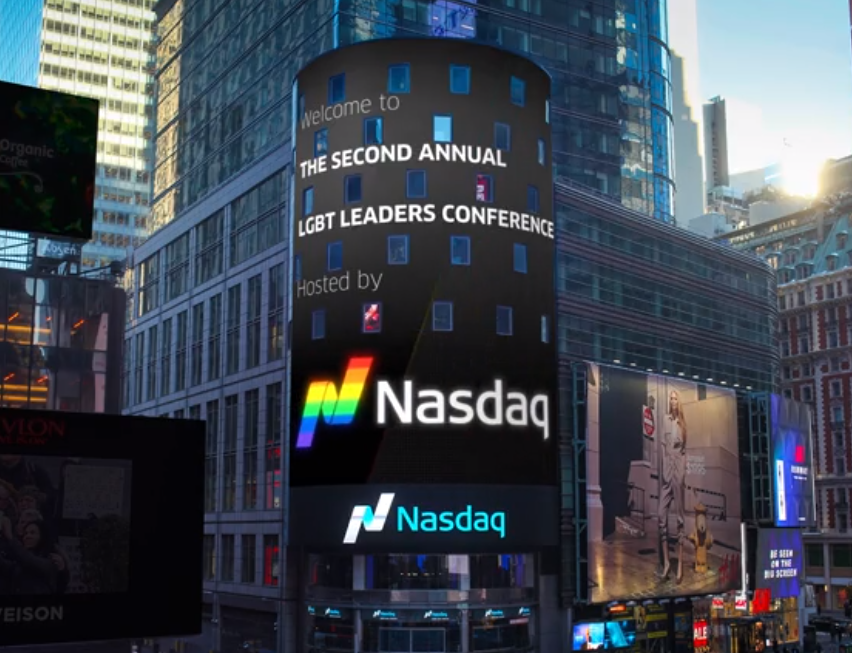
    During the past six months, the Association worked with intermediaries such as J.P. Morgan Advisory Services or the New York Stock Exchange Board Diversity Initiative to highlight LGBTQ+ profiles. Twelve of our members have already joined the NYSE program. We also shared our initiative on the NASDAQ blog. We provided our open-source database of candidates to most recruiters in the industry and already contributed to five specific Board searches.

    Coaching and mapping our members’ Board journey

    The Association onboarded hundreds of LGBTQ+ aspiring and existing Board members in 2022, focusing on an individual approach. This week, we are hosting our second webinar on the theme of “landing a first board seat”. We also developed a guide on the same topic earlier this year. The previous webinar focused on the role of accreditation. We keep in touch with our membership through a weekly newsletter covering the Boardroom as well as topics at the intersection of business and LGBTQ+ news.

    Outside of these key areas, the Association continued to focus on growing the demand by approaching private equity and other institutional shareholders, working with our research partner Equilar on bringing greater transparency on LGBTQ+ Board representation and building corporate partnerships.

    On the international side, the Association supported the creation of the Canadian Association of LGBTQ+ Corporate Directors which has its own Advisory Board (on which Fabrice serves). Similar chapters are at various stages of development in the UK, Australia, Colombia, India, Singapore, and Hong Kong. Fabrice gave remarks on LGBTQ+ Board Diversity at the Annual Women’s Forum in Paris in November 2022 and the London Climate Summit.

    Our team is encouraged by the rapid growth of the Association and its reception in the community and the governance world, clearly highlighting that the Association fills an important gap.

    In 2023, we plan to keep the focus on our three key areas while hopefully building more direct links with US companies to enroll them in this effort. We will also reach out to the mainstream media, specialized magazines, and publications focusing on boardrooms in order to ensure the Association and its members are on every Board’s radar screen. We will also secure additional corporate partners to join our founding sponsor J.P. Morgan.

    Wishing you great holidays.

  • Notes from National Harbor: a glimpse of LGBTQ+ inclusion at the NACD Summit?

    Notes from National Harbor: a glimpse of LGBTQ+ inclusion at the NACD Summit?

    Before joining the Annual Summit of the National Association of Corporate Directors in Washington this week, we carefully cross-examined the list of participants against the lists of the Association of LGBTQ+ Corporate Directors: counting 4 lesbians and 4 gay men (only 3 actual board directors — namely Maggie Fitzpatrick, Romy Diaz and Heather Hiles — the others, candidates) out of about 1000 participants. This number, 0.8%, far from representative of our size in the general population, is on par with our representation in Fortune 500 Boards.

    National Harbor was the place to be for Board Directors this week-end. The National Association of Corporate Directors (NACD)’s Summit was gathering its members October 8–11 at the Convention Center at National Harbor. NACD is the authority on boardroom practices representing more than 23,000 board members but the Summit is also THE Board networking panacea where key relationships are built. To caricature, when a Board opportunity arises, Directors’ thoughts quite naturally turn to the people they had lunch or dinner with at the NACD Annual Summit. Placements happen here.

    So why are LGBTQ+ aspiring and existing Board members absent?

    The absence of LGBTQ+ participants is particularly glaring because the nation’s capital, where the Summit took place, has 9.8% of its entire population identifying as part of the LGBTQ community.

    The reality is that the NACD is not yet a welcoming place for LGBTQ+ individuals and as a consequence many existing and aspiring Board members self-exclude. It is natural that straight Board members whose social life is spent together should also desire to be associated together at such a conference but it makes it very hard for LGBTQ+ people to break in.

    The rhetoric at the Summit has tremendously improved — despite sexual orientation and gender identity being conspicuously absent from the references to diversity in the opening session. The flagship publication “A Framework for Governing Into the Future” mentions LGBTQ+ Board Diversity. In fact it feels that Board diversity was an omnipresent topic during the Summit. The Governance community has successfully convinced itself that, by repeating the words “diversity” and “inclusion” enough time, it is still as it was: an embracing group who makes no unfair distinctions based on gender, race, ethnic background, sexual orientation or gender identity the only factors for getting a seat being skills, vision and character. And yet, in practice, it remains a Club inaccessible to LGBTQ+ people. Beyond rhetoric, a first step towards integration would involve recognizing when LGBTQ+ people are not represented in the spaces one occupies. The main factor preventing LGBTQ+ social integration into dominant spaces is complicit inertia by straight people.

    To me an eye-opening moment was, a Diversity session moderated by Accenture, at the end of which I asked the panelists “LGBTQ+ people are severely underrepresented in the Boardroom and specifically at this conference, what will bring change?” A prominent Director immediately responded “time” seating back in his armchair beaming with self-contentment. My first thought was: “tell that to Charter Communications which, twenty years into the gender diversity conversation, has 1 women out of 14 directors” and my second were the lyrics of my favorite Nina Simone song “they keep on saying “Go slow!””. Time won’t do anything for LGBTQ+ Directors, I could come back to the NACD Summit in ten years from now and the number would have gone from 0.8 to 0.9%. However, I interpreted the response as meaning that this specific director is not feeling responsible for integration. The burden is on us, LGBTQ+ people, to break into the space.

    Not to make it more complex than it is, the reality is that there is no political discrimination against LGBTQ+ people at this point in the boardroom, but there is pervasive social discrimination. During the week, I observed the courageous LGBTQ+ participants witnessing how amalgamation in an “all-straight crowd” is difficult. I was remembering attending a different “all gay” conference here before the pandemic, the 2019 Out & Equal Workplace Summit, and wondering how a straight person would have felt in such an environment. Perhaps more disappointingly, the gatekeepers, recruiters and other sponsors, make no effort to facilitate LGBTQ+ integration or provide support to LGBTQ+ participants. The behavior does not match the generous rhetoric.

    A clear outlier in the community is the visionary NACD Northern California Chapter (ah! California! land of #AB979, never disappoints) that NACD director members in the Capital Valley, San Francisco, and Silicon Valley areas which by the way will host me for their virtual National Coming Out Day LGBTQ Cohort on Tuesday, October 18 (register here). The Chapter and its leaders get it and have been amazingly welcoming. Similarly, two other minority groups, the LCDA (Latinos) and Ascend (Asian-Americans), have been very supportive, lending their hard-earned clout to our group. I am also glad to be part of the newly created Advisory Council to the NACD Center for Inclusive Governance which brings together directors, subject-matter experts and leaders from underrepresented groups to discuss ways to strengthen DE&I in the boardroom. I am hopeful this will trigger change within the Summit too.

    Lisa Spivey of NACD NorCal in conversation with Heather Hiles, Advisory Board Member to the Association

    As I return to mainland DC for our first local dinner of LGBTQ+ aspiring and existing Board members Tuesday night, I have two main takeaways. However uncomfortable it is, LGBTQ+ aspiring and existing Directors have to occupy the spaces they are excluded from as it is the only way these spaces will eventually become comfortable for them. Secondly, the Association of LGBTQ+ Corporate Directors’ approach is the right one: bypassing the ecosystem, to build direct relationships between LGBTQ+ directors and nominating and governance committees while ensuring that LGBTQ+ people lift each other. If you are excluded from a club, consider clubbing together.

  • What are the NASDAQ companies with one or more LGBTQ+ Board members?

    What are the NASDAQ companies with one or more LGBTQ+ Board members?

    Ares Capital (Mary Beth Henson)

    Blackrock (Beth Ford)

    East West Bancorp (Serge Dumont)

    ExP World Holdings

    Grindr (6 members of the current board are LGBTQ+)

    JELD-WEN (Cathy Halligan)

    LivePerson

    New York Times Company (Beth Brooke)

    Nordstrom (Atticus Tysen)

    Papa Johns

    UTZ Brands (Pamela Stewart)

    Vimeo

  • Speech on the occasion of the launch of the Association of LGBTQ+ Corporate Directors

    Speech on the occasion of the launch of the Association of LGBTQ+ Corporate Directors

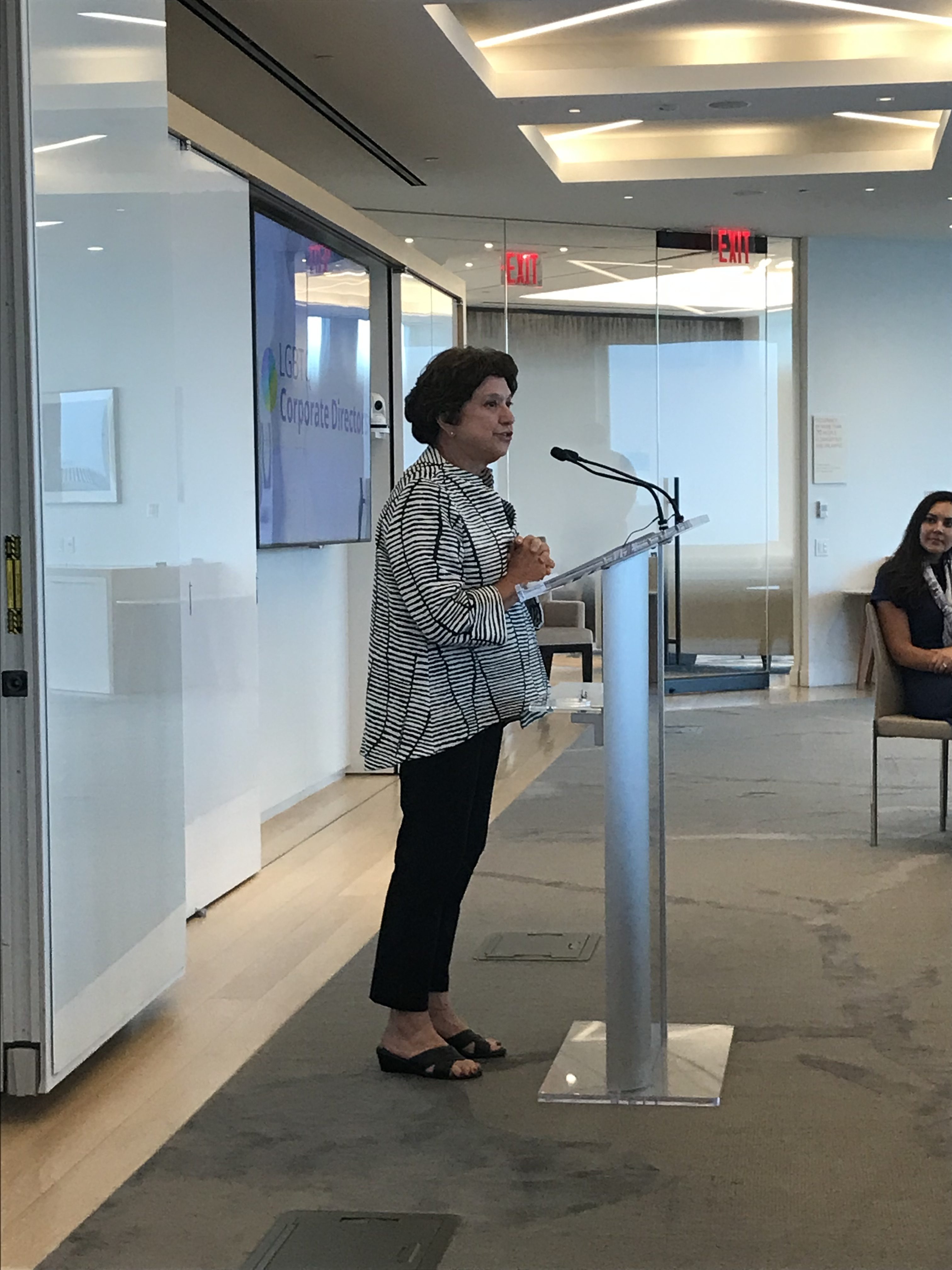
    Thank you for your kind words Betsy and thank you for saying “yes” when I asked you to lend your name, expertise and knowledge to the Association. It is an honor to have you on our Advisory Board. Let me also echo our gratitude to our friends at JP Morgan and in particular Managing Director Brad Baumoel, for hosting our launch event this evening. When I called Brad to ask him about tonight, his immediate response was “Yes, what do you want for dinner?”.

  • Who is Edward Jay Blum the plaintiff against the NASDAQ Board diversity listing rule?

    Who is Edward Jay Blum the plaintiff against the NASDAQ Board diversity listing rule?

    Oral arguments in AFFBR vs. SEC are taking place tomorrow morning but who really is the plaintiff?

    On August 9, 2021, Alliance for Fair Board Recruitment, AFFBR, filed a Petition for Review in the United States Court of Appeals for the Fifth Circuit seeking a review of the approval by the Securities and Exchange Commission (SEC) of the corporate board diversity quotas proposed by the Nasdaq stock exchange. This is one case against Board diversity efforts among several others (see my previous post on legal challenges to date). The oral arguments for Alliance for Fair Board Recruitment v. SEC are taking place in the United States Court of Appeals for the Fifth Circuit this Monday at 9 a.m. (case 21–60626 — see link). AFFBR is represented by Boyden Gray & Associates, a law and strategy firm in Washington, D.C., focused on constitutional and regulatory issues founded by a former Bush White House General Counsel.

    Who really is AFFBR? And what are his motives?

    On paper, AFFBR, is a Texas-based nonprofit with anonymous members who claim to be aspiring directors or shareholders of companies subject to the now repealed SB 826 and AB 979 as well as the NASDAQ listing rule. You can read the opening brief here.

    In reality, AFBBR is Edward Jay Blum, most famously as the executive director of Students for Fair Admission (SFFA) and Project on Fair Representation, which spearheaded an effort to end affirmative-action admissions policies at Harvard University. Blum self-describes as a “politically conservative legal strategist known for his activism against affirmative action based on race and ethnicity”. His deep-pocketed donors included conservative groups according to IRS filings. The National Center for Public Policy Research, a conservative think-tank whose President has claimed that global warming is a religion, is a co-petitioner in the case.

    Blum’s expressed motive to push back on diversity efforts is a belief in the false narrative of American meritocracy. In “An Inconvenient Minority: The Attack on Asian American Excellence and the Fight for Meritocracy” Blum is quoted as saying : “well that’s sign that other races need to step up and do better … I believe competition makes you stronger”. But we can also assume that Blum fears that competent white men might be ‘disfavored’ to make room for diverse students or Board members.

    Proponents of the new listing rule argue that Boards, not unlike Ivy League Schools, have had historically a recruitment process which is much more “cliquish” than meritocratic or competitive. Leveling the playing field is necessary to ensure fairness and a true meritocracy. You can read here the Amicus Brief submitted by the ACLU.

    And beyond this argument, a diverse board yield multiple benefits, including better decision-making to inform key governance issues, being at the forefront of the environmental, social and governance (ESG) agenda, more equitable representation of shareholder and stakeholder needs, better alignment with the company’s employee, customer and supplier base, and dynamic skills, backgrounds and perspectives to anticipate and respond to changing market and consumer trends.

    Despite Blum’s claim that it is discriminatory and therefore unconstitutional, the NASDAQ rule is introducing fairness in Board recruitment but also good governance (see also LGBTQ+ Inclusion in the Boardroom Is Simply Good Governance).

  • How to secure your first Board seat? A 6-steps guide for LGBTQ+ professionals

    How to secure your first Board seat? A 6-steps guide for LGBTQ+ professionals

    As I have mentioned in my previous post, companies are reckoning with LGBTQ+ representation in the American corporate boardroom.

    In August, NASDAQ is starting to mandate disclosure of Board Member’s sexual orientation and gender identity for its listed companies. Concretely, it means that companies are going to have to justify to investors why their all-straight board continues to make sense even when they claim diversity among employees and consumers adds value (see my recent article: What the Grindr Board tells us about other publicly listed companies?)

    The market for LGBTQ+ candidates is about to get hot. Nominating and governance committees, Board recruiters and CEO/founders are increasingly seeking LGBTQ+ board-ready candidates. How will you get on their radar screen?

    Here are six concrete steps I usually suggest to my candidates (from most to least important):

    1. Tell your network you are interested in Board Service

    Your search should be known to all. Mention it at the top of your LinkedIn profile of course. But perhaps more importantly make a list of all the CEOs, Start-up Founders and Board Members in your network and reach out to them individually. Inform them you are looking and ask them for a quick call. I often tell my candidates to ask for advice in their initial email with questions such as “Is accreditation useful? Which program do you recommend?”. And expand your network, by attending the events of your business school alumni association or the local NACD chapter. Remember the vast majority of opportunities are word-of-mouth.

    2. Define your Board expectations

    Besides if you have been CEO or CFO of a Fortune 500 or are a University Dean, Assistant Secretary, leader in science or the head of a large foundation, target smaller companies instead of Fortune 1000 for your first board. In any case, most of the Board opportunities are outside of this grouping. As an example, while many candidates have the National Association of Corporate Directors (NACD) events on their radar screen, they often overlook the Private Directors Association (PDA). There is such a thing as a “board career” — the idea that you could progress to bigger and better boards overtime if you wish.

    3. Make it clear you are part of the LGBTQ+ community

    Relatively to gender or race, it might be harder for companies and recruiters to infer whether you belong to the LGBTQ+ candidate from a simple Google search or an online profile. So why don’t you just tell them upfront? Writing “LGBTQ+ senior professional looking for board service” on top of your LinkedIn profile or Board resume will be a game -changer.

    4. Build a Board resume

    A board resume is a resume with a chapeau”. It’s not rocket science: include your previous and ongoing board experience including non-profit, private boards but also corporate advisory positions. Be specific with committee work or specialization (e.g. “bringing new drug to market”, “Merger & acquisition”, “taking company to IPO”, “defining ESG strategy”). Highlights relevant experience in fundraising, making valuable connections, helping companies grow. Here are hundreds of examples. You can then share it with your network (see 1.).

    5. Seek Board accreditation

    Frankly the main advantages of board accreditation are that these programs give you some “creed” and expand your network. You might even learn something. NACD has a great program so do PDA, Stamford or Harvard. The accreditations programs typically cost between $7,500 to $10,000. Board readiness programs on the other hand, when organized by private companies, can be useless.

    6. Get on the diverse candidates lists

    This is also related to point 3. Create profiles on Board search databases such as Equilar, Diligent, Bolster, BoardProspect, TheBoardlist or the UNC database which started last year to allow LGBTQ+ self-identification. If you are Latino, POC, a Woman, Asian or part of any other minority join the lists of Latino Corporate Director Association, the Board Challenge, the 30% Club or Ascend Pinnacle. So far the number of LGBTQ+ people present in these lists is minimal. As an example: less than 100 people self-identify as LGBTQ+ on the Equilar database which includes thousands of existing and aspiring board members. And get on my own list: the most comprehensive list of LGBTQ+ contacts that are board-ready: it’s free and I try to get visibility for your profile.

    In conclusion, while the demand is about to pick up, LGBTQ+ Board candidates will need to raise their hand in very visible ways. An accomplished straight white male will require a year on average to land his first board opportunity, it can take up to three years for an LGBTQ+ professional of the same caliber. The key is persistence, intentionality and networking.

    Fabrice Houdart specializes in LGBTQ+ representation on corporate boards. He is a member of the Advisory Council of the National Association of Corporate Directors (NACD) Inclusive Governance Center, was listed among the NACD 100 in 2021 and TheBoardList PRIDE 2022 top 10 Candidates. He is an expert witness for the California Department of Justice in two lawsuits against California AB979.